
Creative Response/Voyant:
https://aristotleand.poetry.blog/
Final Paper:
Alexandra Good
Professor Swanstrom
Literature by the Numbers
9 December 2018
How Aristotle’s Poetics Affects Art
Aristotle, who lived during the fourth century, is famous for his writing, ideas, and opinions. His book Aristotle’s Poetics describes Aristotle’s views on theatre, literature, and poetry, describing how writers should create the stories and structure for their poems and plays. Part XV of Aristotle’s Poetics discusses how Aristotle thinks writers should describe their characters and plots. For example, Aristotle states that the main character in a story should be a good person who wants to do the right thing rather than an immoral villain who only wants to hurt people. He believes that a character’s moral compass is very important to the quality of a poem. However, Aristotle also has other requirements for a main character in a well-written poem. He describes how, although a woman in a poem can be a good person, she should not be as noble or heroic as a man. Aristotle also states that people who are enslaved cannot be noble characters in a fictional story. These opinions show Aristotle’s sexist and classist beliefs. Finally, Aristotle believes that a main character should have a reason for what he does during the story. He believes that nothing should be done for no reason at all. Aristotle lived in a much different time period from the twenty-first century, and his opinions about poetry reflect the time in which he lived. Due to this, if a writer in the twenty-first century uses all of Aristotle’s guidelines for a story, the story will seem sexist, outdated, and overdone. However, a few of Aristotle’s guidelines are more timeless. Using all the characteristics of Aristotle’s ideal poems, as described in Aristotle’s Poetics Part XV, can make a poem seem cliché, however, using only a few of these characteristics can make a poem strong as well as unique.
In Aristotle’s opinion, the most important quality for a main character in a fictional story is that they should be a good person. Aristotle states that “in respect of character…first and foremost, it must be good” (Aristotle 15). He also says that “any speech or action that manifests moral purpose of any kind will be expressive of character” (Aristotle 15). Moral purpose is a broad term, however, Aristotle further defines it by stating that “the character will be good if the purpose is good” (Aristotle 15). Similarly, Brittany Asaro describes in her article A Female Hero and Male Antiheros how Aristotle “explains that it is this goodness that will allow the tragic hero to instill in the audience pity and fear” (Asaro 1). If a character is good, the reader or audience will care about that character and want them to succeed. When someone becomes emotionally invested in a character, they will often want to keep watching the play or reading the story. They will want to know what happens to the character, hoping that they will have a happy ending and being afraid that they will have a tragic one. A morally sound and righteous main character is an important literary device for writers because the reader or audience will enjoy the story more and the writer will make more money off of the story. For these reasons, this specific characteristic that Aristotle’s Poetics recommends writers to use in a story is a timeless and effective literary device for all writers, whether they were a part of Aristotle’s time period or the twenty-first century.
As well as a main character who is a good person, Aristotle also expects writers to pay attention to the gender and socioeconomic class of their main character. Aristotle’s Poetics states that “even a woman may be good, and also a slave; though the woman may be said to be an inferior being, and the slave quite worthless” (Aristotle 15). Aristotle goes on to say that “there is a type of manly valor; but valor in a woman, or unscrupulous cleverness is inappropriate” (Aristotle 15). However, Asaro describes how “Aristotle’s definition of the tragic hero in his Poetics indicates a contradiction in one of the great heroes of Greek tragedy” (Asaro 1). She continues to discuss how “the Euripidean Medea centers upon a female hero that is good not inherently, but by speech and action” and how Medea “counters the strict categorization—specifically of genders and tragic heroes—embraced in ancient Greek culture in general and, specifically, in Aristotle’s poetic theory” (Asaro 1). Aristotle and Asaro’s differing opinions about how gender should play a role in how a character acts show how Aristotle has a more archaic and sexist view of women and men. Since Aristotle does not believe that women in poetry should be heroic, he most likely also believes that women in real life can not be heroic. Aristotle is also shown to be classist, stating that someone who is enslaved is not as important as someone who is free. This characteristic of poetry that Aristotle recommends for writers to use is much different from the characteristic of a morally sound main character. Unlike having a morally sound main character, only having heroic main characters be male causes a story to seem cliché rather than unique and interesting. The story will not be as relatable for the women in its audience, which will most likely cause women to be less interested in the story.
Finally, Aristotle’s Poetics describes the importance of necessity in a poem as well as the goodness of a main character and how the writer should handle gender roles. Aristotle describes how “the poet should always aim either at the necessary or the probable” and how “a person of a given character should speak or act in a given way, by the rule either of necessity or of probability” (Aristotle 15). He goes on to say that “within the action (in a story) there must be nothing irrational” so each character in a story should only do things that make sense for that character and that plot (Aristotle 15). Asaro describes how Medea has reasons for “murdering her innocent children” and how “a strict adherence to a heroic code” caused her actions (Asaro 2). Asaro also describes how the reason that Aristotle did not like the character of Medea is most likely because she “is blatantly unfeminine” and “has a reaction at all” to “Jason’s decision to marry Creon’s daughter” (Asaro 3). Asaro sums up her argument by stating that “Medea’s tragic flaw is her possession of the manly valor in women that Aristotle considers inappropriate” (Asaro 3). Medea is a unique and interesting character who has her own reasons for doing the things she does. However, she has the personality traits that would generally be common only for men in the stories written during Aristotle’s time. If the character of Medea were a man, the character would conform more to Aristotle’s ideas for what makes a good story. The character would be a brave man who takes risks for a cause. However, making the character of Medea a man would make the story more cliché, since it was uncommon at the time for woman to be brave and make their own decisions rather than doing what men tell them to do. Due to this, a story can be more interesting if it follows Aristotle’s guidelines for having the characters only do things that need to be done. However, writers should not have to feel as if they need to make their main characters conform to outdated gender stereotypes.
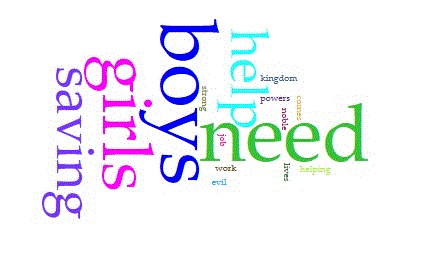
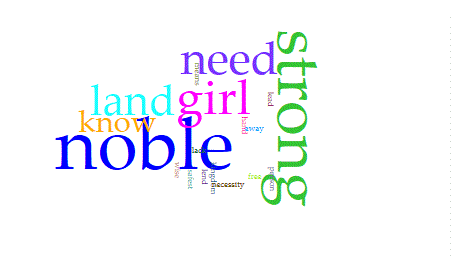
To further show how Aristotle’s ideas affect different works of art, I wrote four different poems, each of which followed Aristotle’s guidelines to a certain degree. Afterwards, I used the online tool Voyant to create clusters of the most common words in the poems. The different words that are the most common in each poem show how following more or less of Aristotle’s guidelines can make poems different from each other.
Overall, following Aristotle’s guidelines for poetry can make a poem more interesting to readers or more cliché depending on which guidelines the writer chooses to follow. For example, if the writer chooses to make the main character a good person, it will cause readers to care more about that character and the story. Similarly, making the main character do things for a certain cause also makes the story more engaging for readers. However, following Aristotle’s gender stereotypes in a story only makes the story more cliché. For these reasons, some of Aristotle’s guidelines for stories are timeless, and others are outdated.
Works Cited
Asaro, B. A Female Hero and Male Antiheroes: An Investigation of the Tragic Hero and Gender Roles in Euripides’ “Medea” According to Aristotle’s “Poetics”. UCLA: Center for the Study of Women. 2010. Retrieved from https://escholarship.org/uc/item/7011m8nz
Aristotle. Poetics. The Internet Classics Archive. S.H. Butcher. http://classics.mit.edu//Aristotle/poetics.html


 Aristotle and Poetry